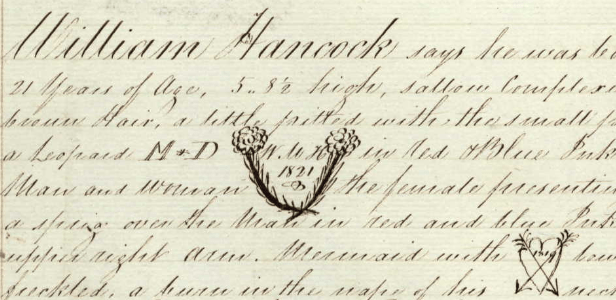
UK Prison Commission Records-Lancaster Gaol- Record of Crown Cases 1820-26. Courtesy of Ancestry UK
Lancaster Castle Gaol records from 1820-1826 capture detailed physical descriptions of the 2000 or so prisoners tried or held in the prison during this short window. Part of these descriptions are of the design and body placement of any tattoos found on them.
The data shows that roughly 20% of all prisoners had tattoos with the proportion of women considerably lower than men. 91% of prisoners with tattoos are male, 9% are female.
The most popular body part to be tattooed was the left arm. Women and younger men/boys favoured the right arm. Hand tattoos are the second most common areas to be tattooed. Several men had chest tattoos. There is some evidence that prisoner’s lower bodies were also searched as injuries are recorded to the legs/feet etc but only one tattoo is recorded as being in this area on a woman’s knee.
The youngest person with tattoos in the dataset is 14, the oldest, 59.
Tattoos at this time are wholly in blue or red ink, I have found no evidence of any other colours available at this time. It is occasionally described as India ink in the records.
There are many reoccuring themes amongst tattoos at this stage; nautical, initials, love, religion and astronomy being the most commonly seen. Mermaids, foul anchors, seven stars or dots, hearts with darts and names are seen time after time. Less common designs featured nature, animals, tattooed rings around fingers or leisure activities. Several prisoners have tattoos with clear links to their occupations, naval, army, craftsman’s tools etc, whilst some have more philosophical or even mystic meanings (Masonic, ‘Face of Knowledge’ etc.)
Click to visit ‘Inked & Inside‘- Prisoner Tattoos in Lancaster Castle
Please be aware that the database contains some adult themes and language
 Lancastrian Research