Date of Conviction: 16/10/1799
Age at Conviction: 17
Crime Convicted of: Theft
Court Convicted at: Lancaster Quarter Sessions (held at the New Bailey, Salford)
Sentence Length: 7 Years
Ship Transported on: Earl Cornwallis
Where Arrived: Port Jackson, New South Wales
Departure Date: 18/11/1800
Arrival Date: 12/06/1801
Biography: Sarah, a single woman, had stolen clothing at Manchester, the property of John Gerrard. Whilst awaiting transportation in jail at Lancaster Castle, the order from government came in October 1800 that her and twelve other female convicts were to be be clothed and sent to Gravesend to board the ship.
Sarah (now more commonly called Leadbeater) met officer William Lawson of the NSW Corps on Norfolk Island. They had a number of children there before Sarah left Norfolk Island in May 1806 with a new baby son born either on or very soon after her journey back and for a few years, returned to Sydney. William followed at the end of the year via Newcastle. Sarah was frequently left to manage the family’s growing estates and farms at Prospect alone as William’s role involved him moving to other penal colonies, as a pastoralist, explorer and even back to England in 1810. In October 1811 Sarah had two letters to collect, presumably announcing William’s imminent return. He finally arrived back in January 1812 and their marriage followed soon after in March 1812 at St Johns, Parramatta. They had eleven children altogether with some lost in infancy and early childhood.
In 1828, the family were living in Prospect, still with seven of their (mostly adult) children. The family home, Veteran Hall, was by now, very large and on a vast acreage.
Sarah passed away at Veteran Hall after a long illness in July 1830 recorded as aged 47 (which ties in with a 1782 baptism of a Sarah Leadbeater in Manchester, child of Thomas and Ann) and was buried on a hill on their land with an English olive tree planted over her. In the 1930s, her grave was discovered by workers (still with nameplate attached) and she was re-interred in a family memorial in St Bartholemew’s Anglican Church.
Sarah was by far the most prosperous of all the Lancastrian female convicts and the only one with a known portrait. The miniature of Sarah contains a lock of brown/auburn hair and, I believe despite its date of late 1790s, is much more likely to be a keepsake Sarah gave to William before he sailed for England in early 1810. Therefore, she is likely to be aged around 27/28 in the portrait.
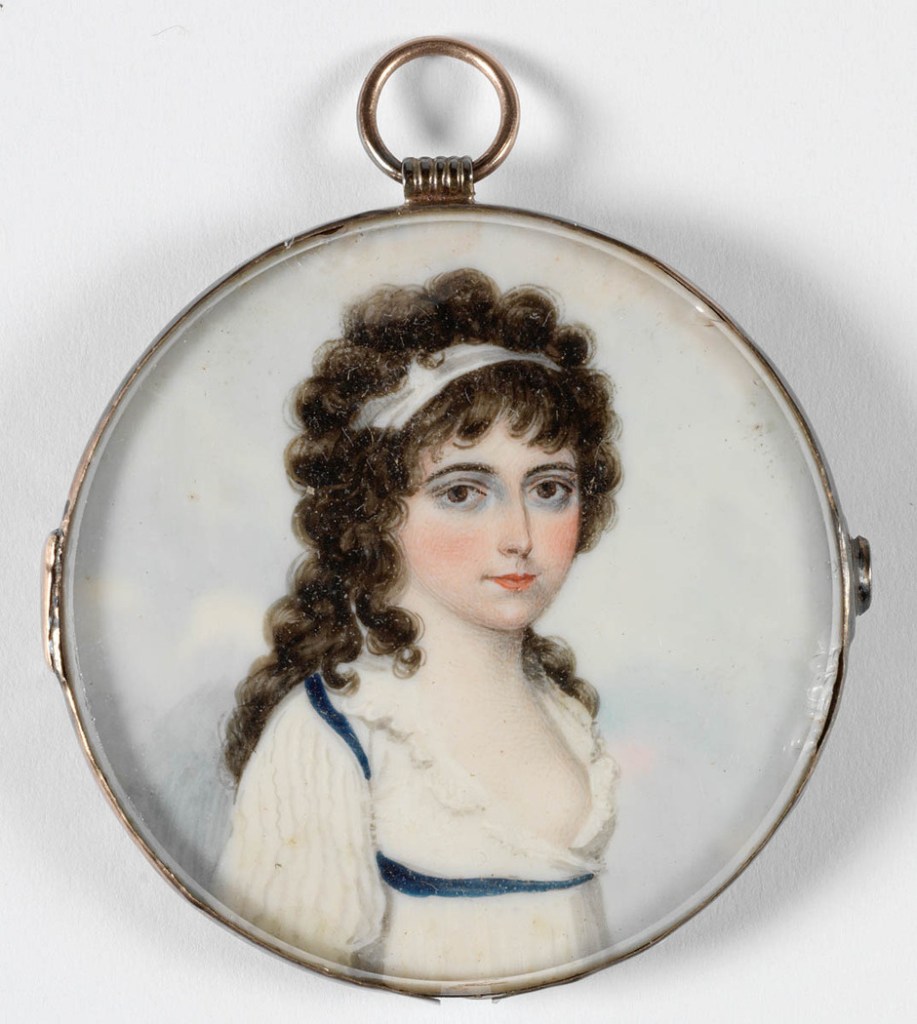
From the collections of New South Wales State Library

